
A large glass door is a statement in itself, inviting in light and allowing people to see both in and out. For standard glass doors like sliders or standard panels, the procedures and mechanisms are well-known. But what about for the largest glass doors in the world? A pane of glass that weighs 40 tons isn’t limited by the furnace making it, but rather by the mechanism that’s going to carry it. Past a certain size and weight, a glass door becomes an impressive feat of mechanical engineering more than anything else.
The Guinness World Record for the largest glass window is currently held by the Taikang Financial Tower in Beijing, measuring 547.5 square feet, 56.1 feet tall, and 6.5 tons. While there is a category for “largest glass window,” there is no listing for the largest glass door. Perhaps this is due to the fact that the distinction between “door” and “window” seems to blur after a certain point.
This article covers some of the largest glass doors in the world (and one series of windows) along with the different mechanisms and engineering solutions that carry them.
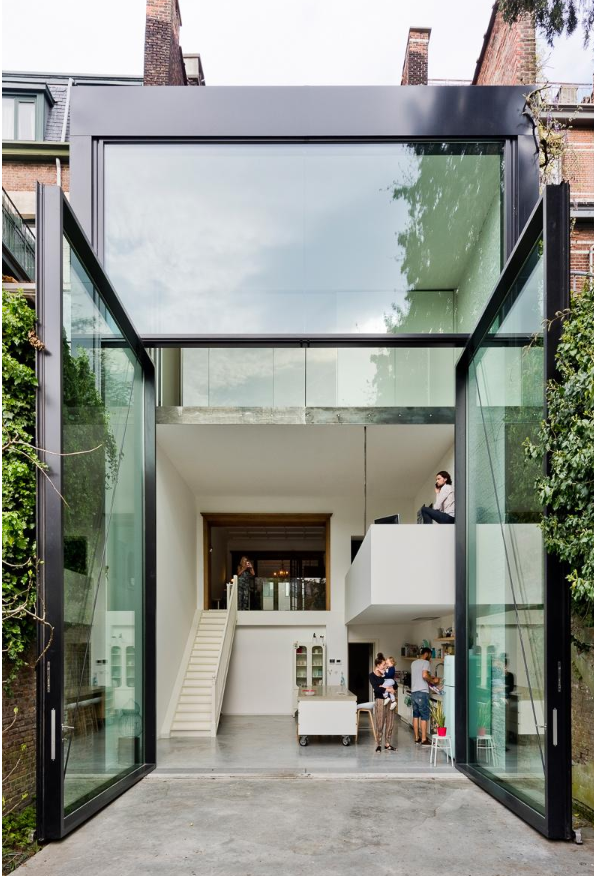
Pivoting Door at LALO House, Antwerp
The enormous pivoting door at LALO House in Antwerp, Belgium, is a spectacle of engineering and architecture. A young couple brought in Architects Pieter Peerlings and Silvia Mertens of Sculp[IT] to update their dated townhouse. The home was built with a “bel étage” layout, meaning the main living area was above ground level and cut off from the backyard. This is a common design in older townhouses in Europe. The couple wanted a way to connect their kitchen to the outdoors, add garden views to the master bedroom and office, and incorporate more natural light throughout the house.
The architects tore down the rear façade of the house in its entirety, replacing it with glass panels that span the full three stories of the home. Within the new glass rear façade, the Sculp[IT] team added two enormous pivoting glass doors, each about 9’10” wide and 19’8″ tall, that serve as the operable openings onto the garden. This link shows some images of the enormous pivoting door.
The panels weigh around 4,400 pounds each and move easily because they use a pivot mechanism, rotating around a balance point near the center of mass rather than on standard hinges. The glass itself wasn’t a challenge, but crafting a steel frame durable enough to carry it was. A custom, reinforced steel frame was designed and built by Lootens Line for this project to support the enormous weight at the pivot points.
Interestingly enough, the Belgian architectural firm Sculp[IT] describes the project as the “world’s largest pivoting window,” though it functions as a door.

Sliding Doors at Apple Union Square, San Francisco
The pivoting door (or window) at the LALO House is huge, but the sliding doors at the Apple flagship store in San Francisco are on an entirely different level. Architectural firm Foster + Partners wanted to design the store to fully open onto Union Square, extending the retail floor out into the plaza outside. The Engineer of Record for the job, Eckersley O’Callaghan, had to figure out a way to create a system so the sliding doors could withstand their own weight, building movement, and the seismic loads San Francisco experiences.
Each of the sliding doors is roughly 20.5 feet wide and 42 feet tall and weighs over 40 tons. The solution was to place the doors on a track and roller system, with specific focus on ensuring the doors (and roller system) stay anchored on the track during an earthquake instead of lifting off it. It takes around seven minutes to fully open or close the doors. You can see what the doors look like here.
Pivoting Doors at U.S. Bank Stadium, Minneapolis
While the doors at LALO House and the Apple Store in Union Square are both impressive, the Legacy Gate at U.S. Bank Stadium in Minneapolis is on its own level. Home to the Minnesota Vikings football team, the stadium gate was designed by architecture firm HKS and features five massive pivoting glass doors (which HKS calls the largest pivoting glass doors in the world). The doors open to connect the stadium concourse with a plaza and to provide views of Minneapolis.
Each of the doors is 55 feet wide, with heights that range from 75 to 95 feet tall as they follow the sloped shape of the building. The doors have a combined 30,000 square feet of glass and weigh 40,000 tons in total.
The doors were custom-designed by Hardesty & Hanover structural engineering firm and manufactured by Industrial Door Contractors Inc., who had never done pivoting doors at this scale and nearly walked away from the project, according to the resident expert on the stadium. However, the challenge proved too compelling, and they took on the task. Instead of the hand-balanced pivot system used by the door at LALO House, the Legacy Gate doors are moved by hydraulic pistons, relying on powered rams instead of a bearing or motor. This link shows what the doors look like at the stadium.


Vertical-Lift Windows at Grand Park Hotel Rovinj, Croatia
While technically not a door, the gigantic lifting windows at Grand Park Hotel Rovinj in Croatia are another feat of engineering worth mentioning. The doors at LALO House, the Union Square Apple Store, and U.S. Bank Stadium all move sideways, but the glass at Grand Park Hotel Rovinj moves upward. The five-star hotel sits on the Adriatic Coast in Croatia, designed by architecture firm 3LHD and interior designers Lissoni & Partners. The restaurant and congress hall were designed to give guests unbroken views of the sea and town of Rovinj, so incorporating mechanisms that required a pocket (like a sliding door) or pivot was ruled out to preserve the sightline. Instead, the hotel uses Vitrosca guillotine windows, which lift straight up.
A guillotine window consists of two glass panels that can rise and lower instead of sliding or swinging sideways. The window is balanced on a counterweight system, so the glass can be raised and doesn’t fight its own weight during the process. This system preserves the view; the glass disappears up into the ceiling instead of off to one side, making it the perfect solution for the restaurant built around the view of the coastline. There are nine guillotine windows throughout the hotel: eight by the restaurant, and one by the pool. The window over the pool is the largest, measuring 15’9” by 18’.
These projects show that creating a large glass door (or moving window) requires specific engineering knowledge and precision, with each project using a different mechanism depending on what the building requires.
When the Glass Gets Bigger, So Does the Engineering
All of the projects mentioned above had a similar engineering problem to solve: how do you move something this large and heavy? For LALO House, it was custom steel hardware to allow the pivot door to move smoothly. The Apple flagship store needed a sliding system that kept the 40-ton doors locked on its track during an earthquake. U.S. Bank Stadium required hydraulics to move the enormous doors, while Grand Park Hotel Rovinj needed a system that would get the windows out of the way of the view.
For a homeowner looking to add a 12-foot pivot door to the patio, a wall of glass that disappears into a pocket for open-air dinner parties, or a wall that slides out of the way to connect the living space and the deck, the solutions are the same, just on a smaller scale. It’s a matter of figuring out how to move something large and heavy without requiring a lot of effort, ensuring it’s easy to use and can handle frequent movement.
Summit Automation handles exactly these solutions. Our systems are configured for sliding and stacking doors, pivot doors, pocket doors, moving windows, and heavy door applications common in luxury builds that feature indoor-outdoor space integration. Systems can be easily controlled through wall pads, handheld touchpads, motion detectors, or even voice integration with Google Home and Alexa. As doors get larger and heavier in pursuit of the perfect indoor-outdoor cohesion in a home, the mechanism behind them is no longer optional; it’s the requirement for making the door usable.
Frequently Asked Questions
Can large glass doors be automated?
Yes, large and heavy glass doors can be automated. For most heavy doors and windows, it can be safer to have automation installed rather than try to move the doors or windows manually. Summit Automation builds motor, gear, and control systems for larger doors and windows.
What is the largest glass door in the world?
Guinness World Records only has a listing for the largest glass window; there is no official record for the largest glass door. By scale, the Legacy Gate Doors at U.S. Bank Stadium in Minneapolis are among the largest glass doors in the world. The Legacy Gate Doors are 95 feet tall (at the tallest) and made of a combined 30,000 square feet of glass.
How long does it take to open the sliding glass doors at Apple Union Square?
It takes about seven minutes to open the sliding glass doors at the Apple Store in Union Square. The doors weigh nearly 40 tons and require slow, controlled movement to stay on the tracks.
Can sliding doors and pivot doors both be automated?
Yes, sliding, stacking, pocket, and pivot doors can all be automated. Each mechanism uses a different system matched to how that specific door moves. See Summit Automation’s configurations page for details on each type, or check out the different videos of each door type to see how they work.
Can an existing glass door be retrofitted with automation?
Yes, though automation is easier to add at design stage, before the door, frame, and structural supports are finalized. When planned in advance, architects and builders working with Summit Automation can design the door and its automation as one system. Retrofitting automation for doors requires adding motors and controls to existing frames and structures, which can be a larger project.
Why do some large glass doors use hydraulics instead of a standard motor?
Some large glass doors use hydraulics instead of a standard motor because powered rams can generate more force than a motor, which matters for doors of incredibly large size or weight. The right mechanism depends on the size and weight of the door, which is why automation systems are usually specified per project rather than one-size-fits-all.